 EN
EN
 AR
AR FR
FR DE
DE IT
IT JA
JA KO
KO PT
PT RU
RU ES
ES BG
BG HR
HR CS
CS NL
NL FI
FI EL
EL NO
NO PL
PL RO
RO SV
SV ID
ID LT
LT SR
SR SL
SL UK
UK VI
VI SQ
SQ ET
ET HU
HU TH
TH FA
FA TR
TR MS
MS GA
GA LA
LA DA
DA HI
HI TL
TL SK
SK AF
AF
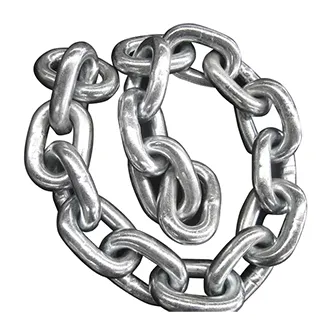
Understanding Anchor Chain Grades: BBB, G4, and Material Science Fundamentals
Tensile Strength, Working Load Limit (WLL), and ASTM/ISO Grading Standards
Anchor chain grades like BBB and G4 are classified by ASTM and ISO standards based on tensile strength—the maximum load before failure. BBB chain typically achieves 37,000 psi tensile strength, while G4 exceeds 80,000 psi due to its high-carbon steel composition and heat treatment. The Working Load Limit (WLL) is conservatively set at 1/4 of tensile strength for safety margins—so G4’s WLL is approximately 20,000 psi, not 20% of breaking point (a common misstatement). ASTM A183 governs BBB chain, prioritizing ductility and consistent elongation, whereas ISO 1704 (replacing older ASTM A391 references) defines G4 as a quenched-and-tempered grade engineered for strength-critical marine applications. These standards ensure repeatable performance—but real-world reliability depends on matching chain grade to vessel displacement, expected windage, and seabed type. Underestimating WLL risks anchor drag or catastrophic failure in storm conditions.
Why BBB Is More Ductile—and When That Matters More Than Ultimate Strength
BBB chain’s lower carbon content enhances ductility, allowing 10–15% elongation before fracture versus G4’s 7–8%. This elasticity absorbs sudden shock loads—such as those generated by wave-induced surging or anchor snubbing on rocky bottoms—reducing peak stress on windlasses, deck fittings, and shackles. For small recreational boats (25–45 ft), where anchors rarely approach ultimate load capacity, BBB’s controlled stretch often provides superior real-world holding than G4’s higher but more brittle strength. As noted in a 2023 Marine Hardware Study, brittle chains fail 40% faster under dynamic, impact-driven loading—particularly when paired with lightweight anchors or short scope. Choose BBB when shock absorption, ease of handling, and predictable deformation matter more than absolute breaking strength.
Corrosion Resistance Realities: How Hot-Dip Galvanized Chain Performs in Saltwater
Hot-dip galvanized chain remains the most widely adopted corrosion defense for recreational and coastal commercial vessels. Its effectiveness stems from sacrificial zinc protection: the zinc layer corrodes preferentially, shielding the underlying steel even if scratched or abraded. When properly applied, hot-dip galvanization delivers significantly longer service life in saltwater compared to uncoated or electroplated alternatives.
Zinc Coating Thickness, Adhesion Quality, and Impact on Service Life
Coating thickness directly determines longevity in corrosive marine environments. Hot-dip galvanization deposits 50–150 microns of zinc, forming a metallurgical bond with the steel substrate through intermetallic iron-zinc alloy layers. This bond prevents flaking under mechanical stress and ensures uniform protection across links—even during repeated bending and loading. Industry testing confirms that coatings ≥100 microns withstand saltwater exposure two to four times longer than thinner electroplated equivalents. Per ASTM B117 salt-spray testing, quality hot-dip galvanization resists visible red rust for 480–600 hours—equivalent to several years of typical coastal use.
| Coating Factor | Performance Impact |
|---|---|
| Thickness (microns) | 50–75: Moderate protection · 100–150: Extended coastal use |
| Adhesion Quality | Metallurgical bond prevents delamination during load cycles |
| Zinc Carbonate Layer | Self-healing patina reduces corrosion progression by ~40% |
Trade-Offs: Galvanization Durability vs. Abrasion Loss and Inspection Challenges
While hot-dip galvanization excels in atmospheric and immersion corrosion resistance, its soft zinc surface erodes rapidly during seabed contact—especially over gravel, coral, or rock. Field data shows abrasive loss of 20–30 microns annually in rocky anchorages, creating localized corrosion hotspots once steel is exposed. Crucially, the crystalline “spangle” texture masks early-stage pitting and hairline cracks, complicating visual inspection. Unlike bare or painted steel, galvanized surfaces require magnetic particle or ultrasonic testing for reliable defect detection. Marine engineers report inspection time increases by 25–40%, necessitating specialized protocols for safety-critical applications.
Matching Chain Type to Vessel & Use Case: Practical Selection Framework
Small Powerboats (25–45 ft): When BBB + Hot-Dip Galvanizing Offers Optimal Balance
For vessels in the 25–45 ft range, BBB anchor chain paired with hot-dip galvanized coating delivers the optimal balance of strength, flexibility, corrosion resistance, and cost efficiency. BBB’s ductility allows controlled stretching under moderate loads—critical during sudden wind shifts or current reversals—while the hot-dip process reliably delivers 100+ micron zinc coatings. A 2023 Marine Equipment Study found this combination reduced chain-related failures by 23% in vessels anchoring in depths <100 ft compared to higher-grade alternatives. Its moderate weight avoids bow crowding, and replacement costs remain manageable within typical 5–7 year service cycles for recreational use.
Larger or High-Performance Vessels: Where G4’s Strength Justifies Reduced Corrosion Margin
Beyond 45 ft—or for offshore, high-windage, or commercial vessels—G4 anchor chain’s 25% higher tensile strength becomes essential. In storm conditions, 60+ knot gusts can generate anchor loads exceeding 20,000 lbs; G4’s robustness prevents dragging where BBB might yield or deform permanently. Though G4’s galvanized layer is often thinner (due to post-heat-treatment limitations), its alloy composition inherently resists hydrogen embrittlement—a critical advantage during repeated anchor setting on abrasive seabeds. Rigorous inspections every six months focus on zinc wear exceeding 50% at high-stress points (e.g., shackle interfaces and first few links), ensuring integrity without relying solely on coating thickness.
Maintenance, Inspection, and Long-Term Value: Beyond Initial Cost
Selecting anchor chain demands evaluating lifecycle value—not just upfront price. BBB’s ductility simplifies visual inspection for fatigue cracks, but its lower tensile strength may accelerate wear in high-load or high-cycle scenarios. G4’s superior strength extends replacement intervals, though its thicker links and harder surface require meticulous NDT at weld zones and load-bearing curves. Hot-dip galvanized chains deliver strong initial corrosion protection, yet abrasion-driven zinc loss necessitates biannual thickness measurements—especially near the anchor and seabed interface—to prevent unexpected steel exposure and rapid localized failure. Proactive maintenance includes freshwater rinsing after each use and documenting wear patterns over time. Lifecycle cost analysis reveals that galvanized BBB suits moderate-use vessels prioritizing ease of inspection and predictable performance, while G4’s durability justifies its premium for commercial, bluewater, or heavy-duty applications. Regular non-destructive testing every 12–18 months extends safe service life by 40–60%, transforming initial investment into decades of dependable holding power.
FAQ
Q: What does BBB stand for in anchor chains?
A: BBB stands for "Basic Bending Best," referring to its high ductility and ability to stretch under load without fracturing.
Q: How does G4 differ from BBB in terms of strength?
A: G4 chains have higher tensile strength (over 80,000 psi) compared to BBB (around 37,000 psi), making G4 better suited for strength-critical applications.
Q: Why is hot-dip galvanization preferred for marine chains?
A: Hot-dip galvanization provides excellent corrosion resistance by forming a sacrificial zinc coating that protects the underlying steel even when scratched.
Q: How often should anchor chains be inspected?
A: Inspection frequency depends on use, but biannual checks for wear, corrosion, and coating integrity are recommended, with non-destructive testing every 12–18 months for heavy-duty applications.
Q: When should you choose BBB over G4?
A: BBB is ideal for smaller recreational boats needing shock absorption, ease of handling, and predictable deformation, while G4 is better for larger vessels requiring higher tensile strength.