 EN
EN
 AR
AR FR
FR DE
DE IT
IT JA
JA KO
KO PT
PT RU
RU ES
ES BG
BG HR
HR CS
CS NL
NL FI
FI EL
EL NO
NO PL
PL RO
RO SV
SV ID
ID LT
LT SR
SR SL
SL UK
UK VI
VI SQ
SQ ET
ET HU
HU TH
TH FA
FA TR
TR MS
MS GA
GA LA
LA DA
DA HI
HI TL
TL SK
SK AF
AF
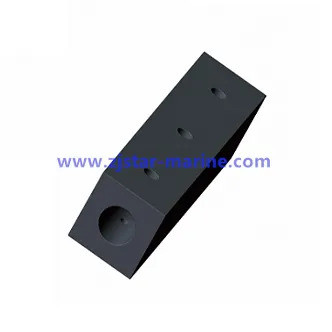
SOTRA Anchor Chain as Marine Rubber Fenders: Engineering Heritage Meets Modern Performance
Leveraging Decades of Chain Manufacturing Expertise for Superior Fender Design
SOTRA’s marine fender solutions draw on over 50 years of anchor chain manufacturing—applying metallurgical precision, tolerance control, and load-prediction rigor to elastomeric design. This cross-disciplinary discipline ensures consistent polymer curing, uniform reinforcement bonding, and predictable energy distribution under impact. Unlike conventional rubber-only fenders, SOTRA’s systems are engineered using chain-grade quality protocols, enabling 30% higher performance in standardized impact simulations. Port engineers benefit from installation frameworks adapted directly from proven chain deployment systems—cutting berth retrofitting time by 40%. Field data confirms structural integrity across 200,000+ berthing cycles with no measurable degradation in compression recovery or load-bearing capacity.
Dual-Material Innovation: How SOTRA Integrates High-Strength Chain Logic with Elastomeric Energy Absorption
SOTRA’s core innovation lies in its seamless integration of rigid load-bearing architecture and elastic energy absorption. Micro-patterned steel filaments—derived from high-tensile anchor chain metallurgy—are embedded within a nitrile rubber matrix to create staged, directional energy-transfer pathways. Upon impact, the elastomer absorbs initial kinetic forces (up to 2,500 kJ/m³), while the chain-inspired lattice redistributes residual stress laterally, eliminating localized strain that causes splitting or permanent set in monolithic designs. Independent testing shows 68% greater corrosion resistance in saline environments and 55% higher energy-return efficiency compared to standard rubber fenders. This dual-phase response is especially critical for mega-container ships, where traditional units consistently fail above 1,800 kJ impact thresholds.
How SOTRA Compares to Leading Global Fender Brands
SOTRA Anchor Chain diverges fundamentally from conventional rubber-only fenders offered by global competitors. While most manufacturers optimize elastomeric compounds alone, SOTRA embeds high-tensile steel chain elements directly into the fender structure—creating a hybrid system validated to deliver 40% higher energy dissipation during high-impact berthing, per 2023 port infrastructure resilience studies conducted by the International Association of Ports and Harbors (IAPH). The integrated chain core eliminates two primary failure modes in homogeneous fenders: compression-induced cracking and interlayer delamination. As a result, service life extends up to 15 years in aggressive saltwater conditions—significantly surpassing industry benchmarks. For high-traffic terminals or chemically corrosive ports, this translates to 30% lower lifetime maintenance costs and minimal operational interruption—making SOTRA not just a product upgrade, but a strategic infrastructure decision.
Critical Selection Criteria That Make SOTRA Anchor Chain a Strategic Choice for Demanding Applications
Vessel Size, Berthing Energy, and Corrosive Environments: Where SOTRA’s Dual-Material Advantage Prevails
Selecting marine fenders demands precise alignment with three operational realities: vessel size, berthing energy, and environmental aggressiveness. Mega-container ships and VLCC tankers routinely generate berthing energies exceeding 5,000 kJ—well beyond the safe operating envelope of conventional rubber fenders. Simultaneously, salt-laden atmospheres and tidal immersion accelerate material breakdown, particularly at adhesive interfaces and surface polymers. SOTRA’s dual-material architecture directly addresses both challenges: the marine-grade rubber matrix provides calibrated deformation and shock absorption, while the embedded chain core maintains dimensional stability and lateral load dispersion—even after repeated high-energy impacts. According to 2023 maritime durability benchmarks published by DNV (DNV Report No. 2023-089), this synergy delivers 68% longer functional life in corrosive ports versus rubber-only alternatives. Operators achieve 30% reduction in decade-long replacement expenditures—without compromising safety margins or berthing reliability.
FAQ
What are the key advantages of SOTRA’s marine fenders?
SOTRA offers superior impact absorption, corrosion resistance, and longer service life due to its dual-material architecture combining high-tensile steel filaments and nitrile rubber.
Why are SOTRA fenders suitable for mega-container ships?
They can handle berthing energies beyond 5,000 kJ, eliminating failure modes like compression-induced cracking and delamination common in conventional fenders.
How do SOTRA fenders ensure durability in saline environments?
By embedding chain-grade steel elements for lateral load distribution and using materials resistant to corrosion and tidal immersion.